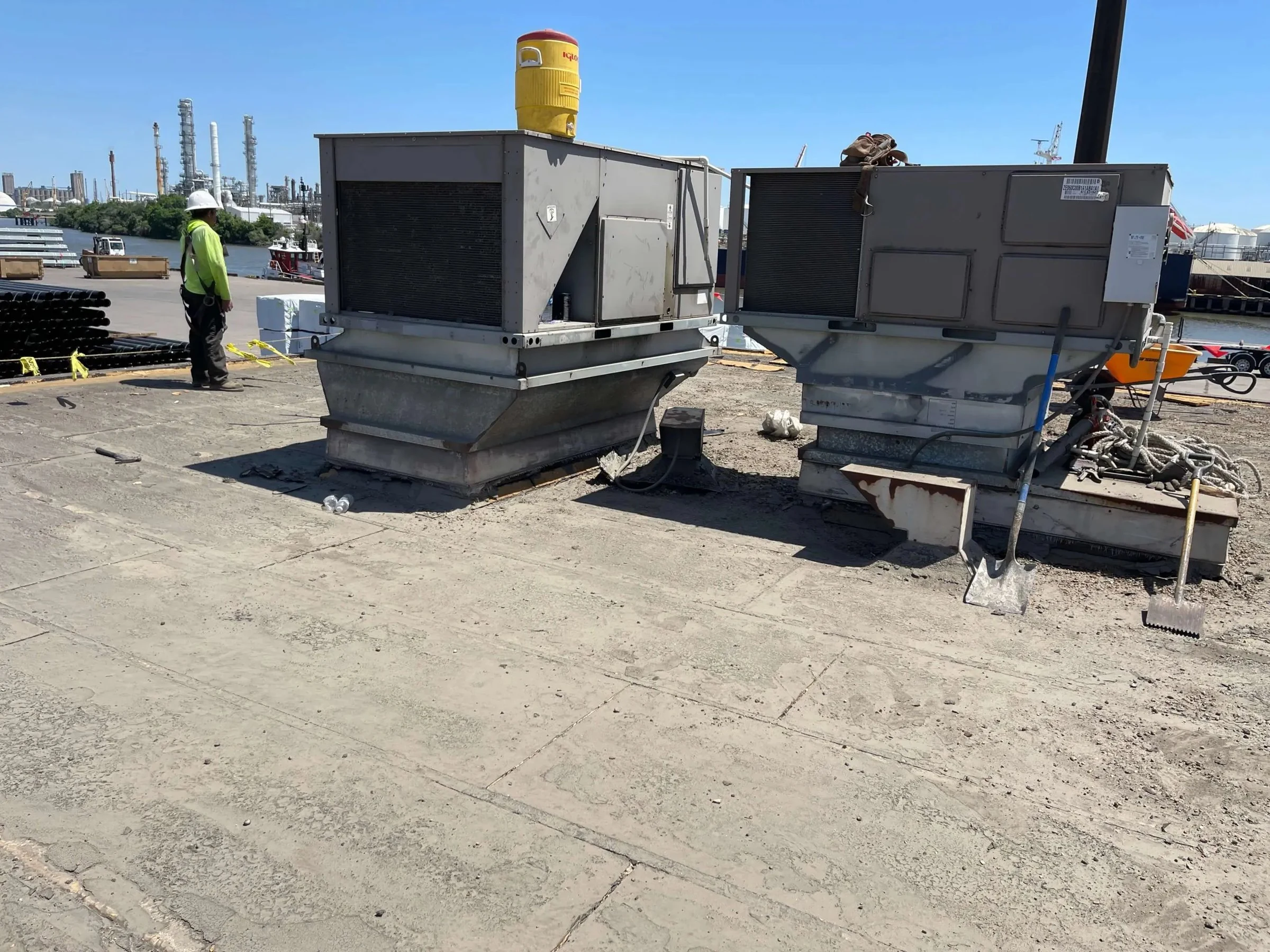
PVC Membrane for Hospital and Food-Grade Roofs at Fitzsimons
PVC comes up first on our estimates whenever a rooftop has grease exhaust, chemical fume discharge, or heavy mechanical equipment tied to a hospital, lab, or food-handling operation. The Fitzsimons medical campus and Commerce City's food and industrial corridor are where this membrane earns its higher bid line most often.
Chemical and Grease Resistance the Other Membranes Do Not Match
PVC's resin chemistry resists petroleum-based greases, oils, and many common industrial and kitchen exhaust byproducts better than TPO or EPDM. On a hospital roof at Anschutz with kitchen exhaust fans, lab fume discharge, or generator exhaust running across the membrane surface, that resistance is not a marketing point, it is the reason the membrane holds up instead of softening or degrading at the exhaust discharge points.
Food-processing and cold-storage buildings in the Commerce City corridor carry similar exhaust and refrigerant-line conditions, and we spec PVC there for the same reason, not because of a facility-type checklist but because of what is actually venting across the roof surface.
Heat-Welded Seams and Long-Term Seam Integrity
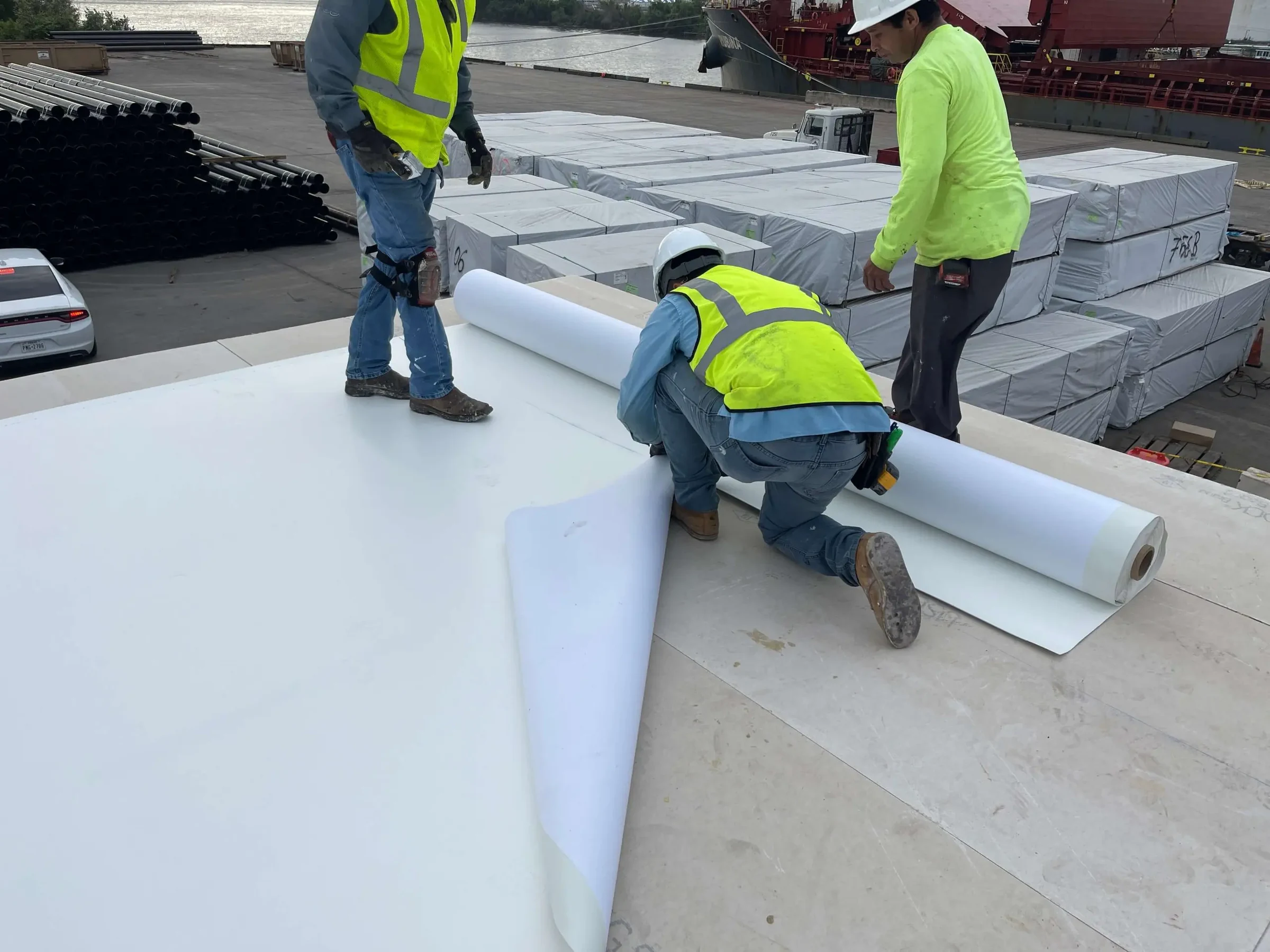
Like TPO, PVC seams are hot-air welded rather than adhesive-bonded, which gives a monolithic seam rather than a bonded lap joint. One technical point we walk owners through directly: PVC membranes contain plasticizers that keep the sheet flexible, and plasticizer content can migrate out of the membrane over a multi-decade service life, which is a known industry consideration with older PVC formulations. Current manufacturer PVC products are formulated to hold plasticizer content over a longer service window than older-generation sheet, and we spec current product lines, not legacy formulations, on every PVC bid.
Impact Performance With Reinforcement and Cover Board
Reinforced PVC membranes, backed by an appropriate cover board, show up in FM 4473 and UL 2218 Class 4 rated assemblies in the same way reinforced TPO does. The reinforcing scrim inside the membrane matters as much as the surface thickness for impact performance, and we confirm scrim weight and cover board spec together before quoting a hail-rated PVC assembly for a Denver-metro building.
Rooftop Equipment Load at Anschutz
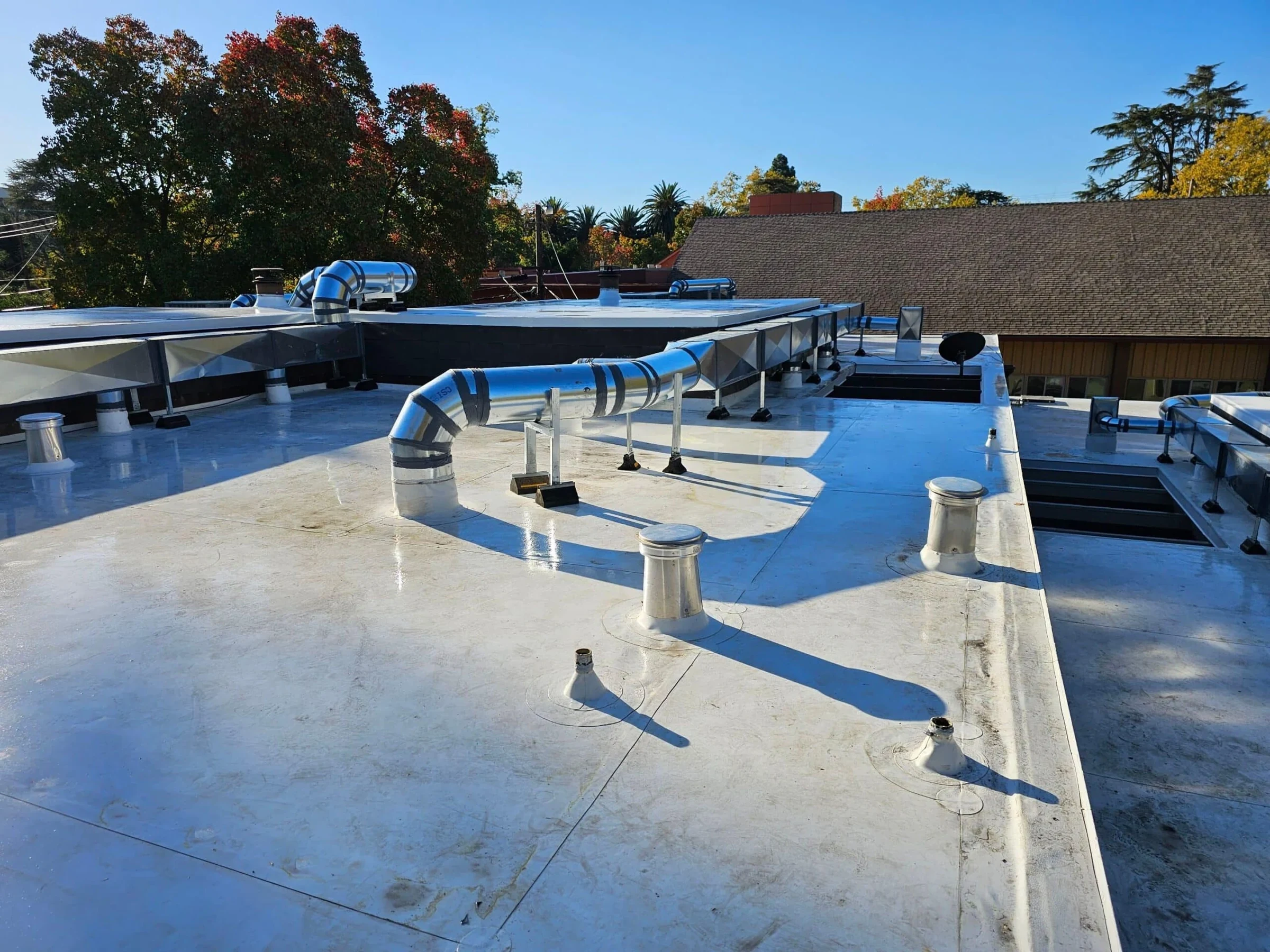
Hospital and bioscience buildings on the Anschutz Medical Campus carry dense rooftop mechanical loads: air handlers, exhaust stacks, chillers, and lab-specific equipment often added incrementally over years. PVC's weldable detail work around curbs and penetrations makes it practical to flash a roof with a high penetration count without relying on field-cut patches that age faster than factory-formed detail pieces.
We map every curb, stack, and support pad on a pre-install walk before ordering material for a campus building, since a hospital or research roof added onto over a decade often has more penetrations than the original drawings show. Factory-formed PVC boots and corners cut down on field welding time at each of those points, which matters when a facility cannot schedule an extended roof closure around active clinical space.
- Hospital and lab buildings with kitchen, fume, or generator exhaust across the roof
- Food-processing and cold-storage facilities with refrigerant lines and grease exhaust
- Roofs with dense, incrementally added rooftop mechanical equipment
- Buildings requiring hail-rated assemblies with reinforced membrane and cover board
- Institutional roofs where long-term chemical exposure is documented
Cost Per Square Foot Against the Exposure It Solves
PVC typically prices above standard TPO per square foot, and we do not recommend it on a building without a chemical, grease, or exhaust exposure that justifies the premium. For a hospital kitchen roof or a cold-storage facility, the lifecycle math favors PVC because a TPO or EPDM membrane degrading at exhaust discharge points generates repeat repair calls that erase the upfront savings within a few years.
We separate the exposed zones from the rest of the roof field on larger buildings when it makes budget sense, using PVC around exhaust and mechanical zones and a standard membrane elsewhere, rather than defaulting the entire roof to the premium system when only part of it needs that resistance.
That zoned approach requires a clean transition detail between membrane types, and we treat that transition as its own line item on the estimate rather than an afterthought, since a poorly detailed transition seam is a more likely failure point than either membrane field on its own. We document the transition location on the closeout drawings so a future contractor knows exactly where the membrane change happens.
PVC Roofing Questions From Facilities and Property Teams
Does every hospital roof need PVC membrane?
No. We spec PVC specifically where exhaust, grease, or chemical exposure is documented on the roof, not as a default for every institutional building.
Is PVC more expensive than TPO?
Generally yes, per square foot. We only recommend it where the chemical or grease exposure justifies the premium against the repair costs of a membrane not rated for that exposure.
What is the plasticizer concern with PVC membrane?
Older PVC formulations could lose flexibility over time as plasticizer content migrated out of the sheet. Current manufacturer product lines are formulated to hold that content over a longer service window, and that is what we spec.
Can PVC be used only in exhaust and mechanical zones with TPO elsewhere?
Yes, on larger roofs this is a common way to control cost while still protecting the zones that actually see chemical or grease exposure.
How are PVC seams different from EPDM seams?
PVC seams are hot-air welded into a monolithic joint, similar to TPO. EPDM seams are adhesive-bonded lap joints. Both are reliable when installed within the correct temperature and surface-prep parameters.