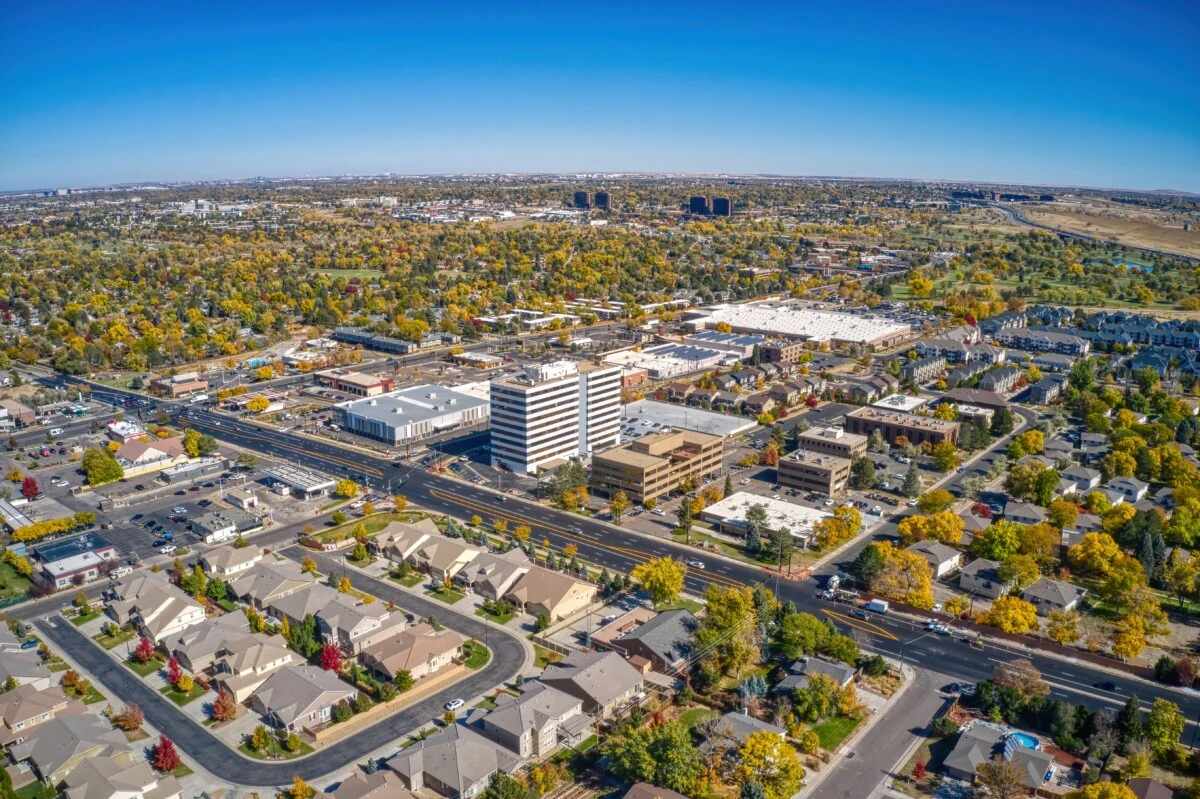
Commercial Roofers in Meridian
For commercial properties in Meridian, the defensible choice between repair, restoration, and replacement starts with roof-system condition, moisture findings, drainage performance, and remaining service life. Meridian's office campuses sit along one of the most visible stretches of the I-25 corridor south of Denver, competing for corporate tenants against the Denver Tech Center and Inverness. Roof condition here is tied directly to leasing curb appeal in a way it is not in a purely industrial submarket, so Commercial Roofers of Aurora prices Meridian projects with both performance and appearance in the estimate.
Large-Plate Corporate Buildings and Their Roof Economics
Much of Meridian's office product uses large single- or multi-tenant floor plates with correspondingly large, mostly unobstructed roof fields, broken up by rooftop mechanical zones and occasional atrium or clerestory penetrations. That geometry is actually favorable for reroofing cost: fewer penetrations per square foot than a retail strip or a hospital means lower labor cost per square foot for the field membrane, even though the overall project size is larger.
Where the cost concentrates is at the mechanical yards and the parapet detailing that is visible from I-25 and County Line Road. Owners competing for corporate tenants in this corridor care about how the building presents from the highway, and a roof edge with mismatched coping or visible patch repairs works against leasing just as much as an aging lobby does.
Ballasted-to-Membrane Conversions
A number of Meridian's original-construction roofs went in as ballasted EPDM, which was a common, cost-effective choice for large flat roofs in the 1990s and early 2000s. Ballasted systems are heavy, the stone layer alone adds significant dead load, and when an owner decides to convert to a mechanically fastened or fully adhered membrane during a reroof, we verify the structural deck can handle the load change in either direction before committing to a system.
Converting away from ballast also opens up reflectivity options that were not available under a stone surface, which matters for owners chasing energy code compliance or a cooler roof surface to reduce top-floor cooling load in tenant suites closest to the roof deck.
Wind Exposure at the Foothills' Edge
The I-25 corridor south of Denver sits close enough to the Front Range to catch downslope wind events that do not reach the flatter ground further east, and those chinook winds can push sustained gusts well above what a roof further from the foothills has to handle. We spec fastening patterns and FM uplift ratings to the exposure category for this specific stretch of corridor rather than defaulting to a citywide standard, because a membrane that holds on a sheltered lot in Parker can still lift at the perimeter here during a January wind event.
We have seen roof edge damage concentrate on the west and northwest corners of Meridian buildings after major wind events, which lines up with the direction most chinook activity comes from. On a reroof, we specify enhanced fastening density in those corner and perimeter zones rather than applying a uniform pattern across the whole field, since that is where the uplift pressure actually concentrates.
Comparing System Options for a Corporate Roof
We run every Meridian corporate estimate against at least two system options, because owners here are usually weighing installed cost against how the choice affects leasing and holding-period economics, not solely against roofing cost. Typical comparison points:
- Installed cost per square foot for TPO, PVC, and EPDM options
- Reflectivity and its effect on top-floor tenant comfort and energy cost
- Visual presentation from I-25 and the building's main approach
- Warranty term available and what it requires for annual maintenance
- Weight impact if converting away from an existing ballasted system
- Expected service life before the next capital event
None of these comparisons matter much if the underlying deck condition is compromised, so we always confirm deck condition before running the cost model, since a soft deck changes the fastening approach regardless of which membrane an owner ultimately prefers.
Maintenance Programs Tied to Leasing Cycles
For owners actively marketing space, we time non-emergency roof maintenance, coating touch-ups, sealant renewal at parapet caps, drain clearing, around major prospect tours where possible, so a roof crew and material staging are not part of a tenant's first impression of the building. Preventive maintenance contracts here also catch the small failures, a split boot, a clogged scupper, before they turn into a stained ceiling tile in a suite an owner is trying to lease.
We also flag roof condition issues in writing as part of every maintenance visit, giving ownership a running record they can hand to a broker or a prospective buyer if the asset goes to market. A documented maintenance history carries real weight in a due diligence process, and it costs nothing extra to keep once the inspection is already happening.
Common Questions Along the Meridian Corridor
Should we convert away from our existing ballasted roof?
It depends on the deck's load capacity and your reflectivity goals. We check the structural numbers before recommending a conversion, since removing ballast changes the dead load calculation in ways that need engineering review.
How much does wind exposure here really affect the spec?
Meaningfully. This stretch of I-25 catches downslope wind events that push gusts higher than more sheltered parts of the south metro, so we spec fastening and uplift ratings to that specific exposure.
Can roof work be scheduled around tenant tours?
Yes, for non-emergency maintenance and most reroof phases. We will work with your leasing team's calendar to keep heavy equipment and staging away from scheduled tours.
Does a white reflective roof actually lower tenant cooling costs?
On the top floor of a building, a reflective membrane can measurably reduce the cooling load coming through the roof deck, though the total energy impact depends on insulation levels and the mechanical system already in place.
What's driving most of the reroof decisions in this corridor right now?
Age is the biggest factor. A lot of Meridian's original 1990s and early-2000s roofs are reaching the end of their warranted life at the same time, which is pushing several owners toward a decision within a similar window.