Commercial Roofers in Littleton
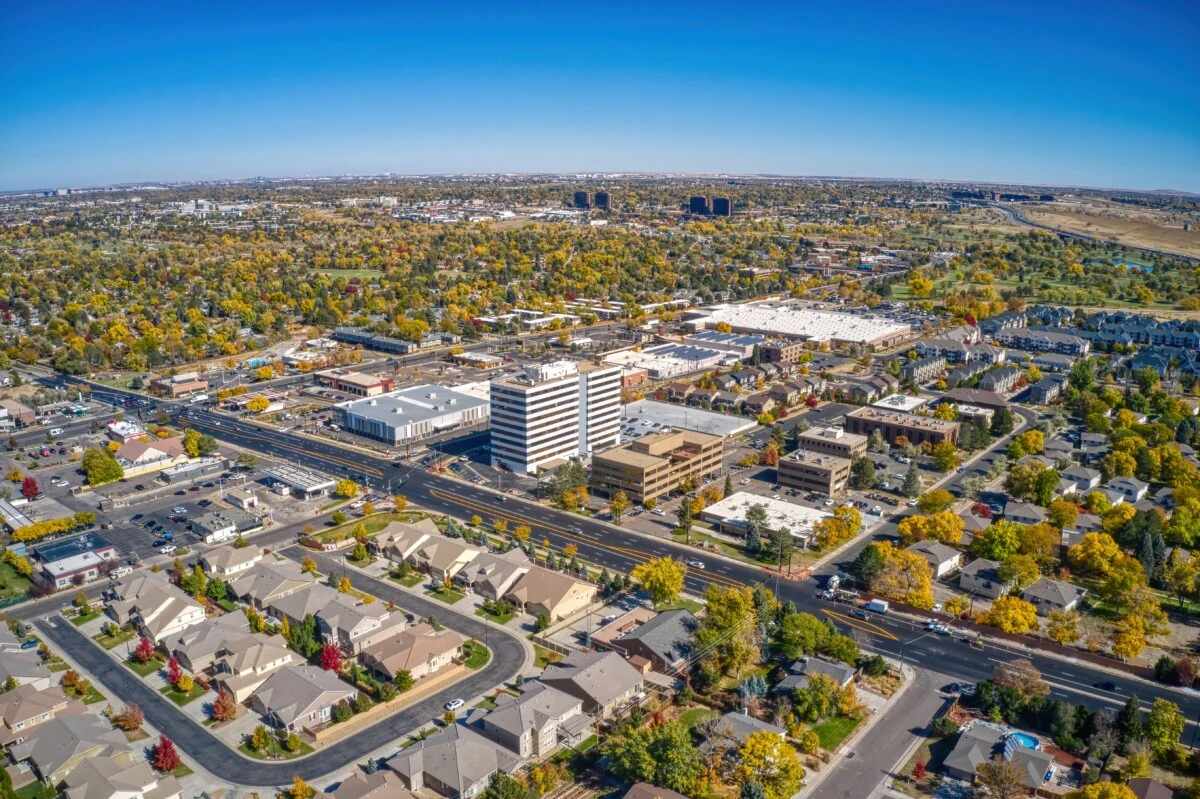
For commercial properties in Littleton, the defensible choice between repair, restoration, and replacement starts with roof-system condition, moisture findings, drainage performance, and remaining service life. Littleton's commercial roof stock covers three distinct categories inside a few miles of each other: a hospital campus with roof requirements tied directly to patient care, a historic downtown of small brick retail buildings with decades-old flat-roof additions, and an industrial corridor along Santa Fe Drive. Commercial Roofers of Aurora prices each category on its own terms rather than applying one standard spec across all three.
Roofing a Hospital Without Disrupting Patient Care
Hospital roof work carries a different risk profile than almost any other commercial building type. A leak over a mechanical room is an inconvenience, a leak over a surgical suite or a sterile processing area is a clinical problem, and infection control requirements mean dust, debris, and moisture intrusion during construction have to be controlled far more tightly than on a typical reroof. We coordinate directly with facilities and infection-control staff before work starts, sequence tear-off in small sections to limit exposed roof area at any given time, and keep a dry-in plan ready for every shift in case weather turns faster than the forecast predicted.
Hospital roofs also carry heavier and denser mechanical loads than almost any other building type in Littleton, air handling units sized for negative-pressure isolation rooms, medical gas vents, generator exhaust, and each of those systems has to stay operational throughout the project. We do not touch a curb or a unit connection without confirming with facilities engineering first.
Downtown's Historic Brick Buildings and Their Flat-Roof Additions
Historic downtown Littleton's retail buildings were mostly built with the original structure decades before flat commercial roofing became standard, and many carry later additions or rear extensions with low-slope roofs bolted onto an older masonry structure. Those transition points, where a newer flat roof meets an older parapet or an adjoining building's wall, are where we find the most persistent leak history downtown, not in the field membrane itself.
Working downtown also means tighter access than a suburban strip center, similar to what we see in denser parts of the metro: limited staging space, street parking to work around, and in some cases historic district guidelines on what is visible from Main Street or Littleton Boulevard.
Santa Fe Drive's Industrial Buildings
South of downtown, the industrial and flex buildings along Santa Fe Drive are a more straightforward roofing problem: single-story steel construction, mostly modified bitumen or aging single-ply, due for a recover or replacement decision after twenty-plus years of service. We approach these buildings the same way we approach similar stock in Sheridan and Englewood, with a core cut and moisture survey before recommending a system.
A number of these buildings also share walls or loading areas with neighboring tenants, which changes how we sequence tear-off to avoid dropping debris or opening a section of roof over an occupied neighbor's space during business hours.
Building-Type Comparison for Littleton Owners
Owners across these three building types tend to ask the same underlying question in different language: what is the honest lifespan left on this roof, and what does the next ten years cost either way. A quick comparison by building type:
- Hospital and medical buildings: phased work, infection control, mechanical redundancy
- Downtown retail: transition flashing at old-to-new roof interfaces, historic district review
- Santa Fe industrial: recover-versus-replace economics on aging single-ply and modified bitumen
- Multi-tenant medical office near the hospital campus: coordinated scheduling across several practices
- Older municipal and school buildings: budget-cycle timing tied to public funding calendars
We price each category against its own realistic budget cycle rather than a single citywide average, since a hospital's capital planning calendar and a downtown retail owner's cash-flow reality have almost nothing in common.
Snow Load and Freeze-Thaw at the Foothills' Edge
Littleton sits close enough to the foothills that heavy, wet spring snowstorms hit here with more moisture content than the drier snow further out on the plains, adding real weight to a roof deck during a late-season storm. Combined with the freeze-thaw cycling typical of a Front Range winter, drainage that clears fine in a normal week can back up fast when a spring storm dumps a foot of heavy snow that then melts and refreezes over a few days. We check drain and downspout capacity against this specific pattern on every Littleton assessment, not solely against a generic annual rainfall number.
We also check that downtown's older buildings have functioning heat trace or adequate insulation at valleys and internal drain locations, since an ice dam that forms at a poorly insulated valley can back water up under the membrane well before the bulk of the snow load has even melted.
Littleton FAQ: Hospitals, Downtown, and Industrial Roofs
Can hospital roof work happen without disrupting surgery schedules?
Yes, with the right sequencing. We phase tear-off in small sections, coordinate directly with facilities and infection control, and keep every mechanical system tied to patient care operational throughout the project.
Why do downtown buildings leak at the roof transitions instead of the field?
Because most of downtown's low-slope roofs were added onto older masonry structures decades after original construction, the transition flashing at those junctions is usually older and more failure-prone than the membrane itself.
Are there historic district rules for downtown roof work?
In some cases, yes, particularly for anything visible from Main Street or Littleton Boulevard. We confirm what applies to your building before finalizing the spec.
Does spring snow really matter more than winter snow for roof drainage?
Yes. Late-season storms near the foothills tend to carry more moisture content than midwinter snow, which adds more weight and more meltwater volume for the drainage system to handle in a short window.
How do you price a recover on an older Santa Fe Drive building?
We start with a core cut and moisture survey to confirm the existing insulation is dry, then compare recover cost against full tear-off over a 15- and 20-year horizon before recommending either option.