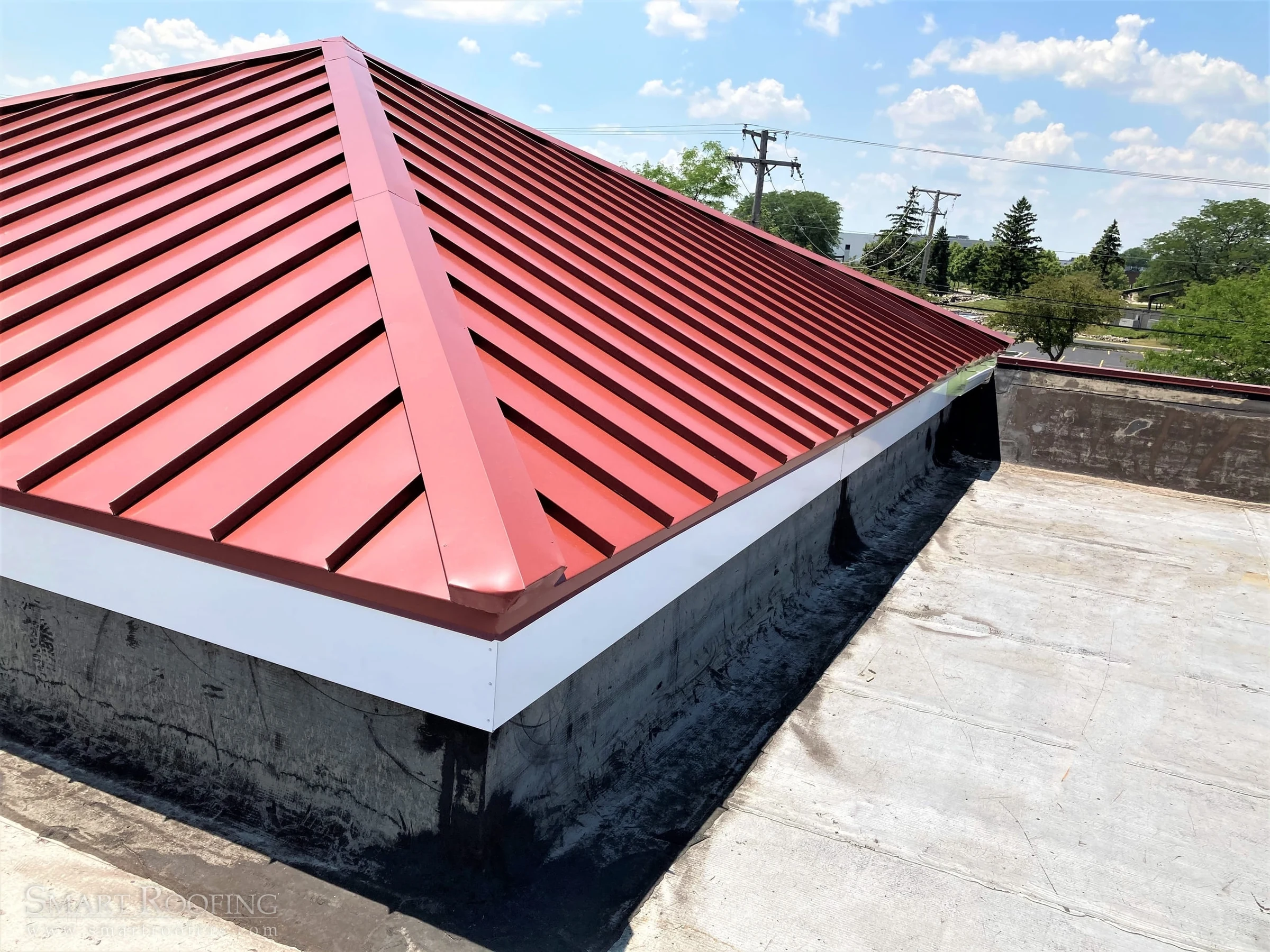
Standing Seam for Retail Fronts That Take the Hail Head-On
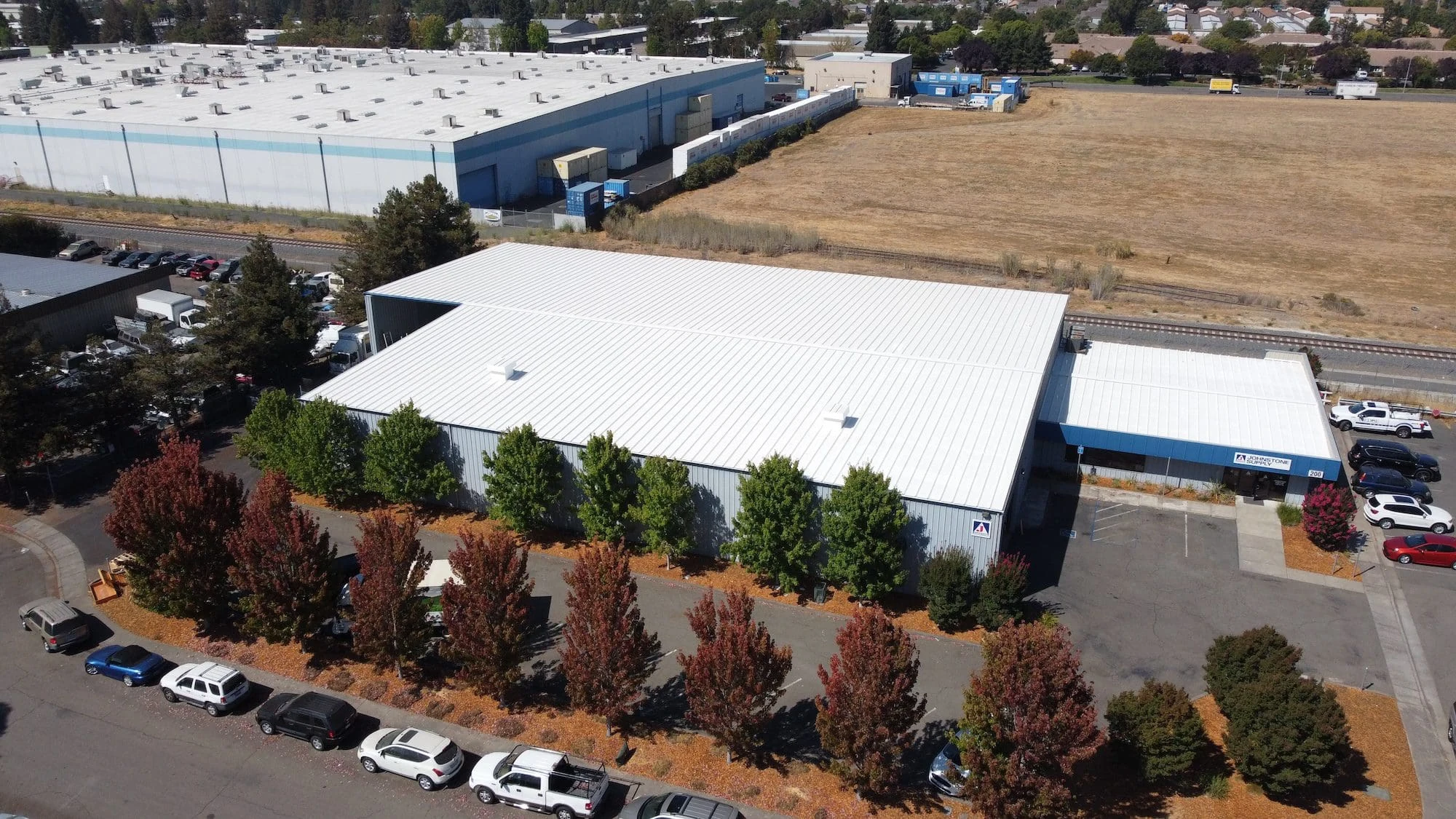
Standing seam metal shows up on entry canopies, tower features, and full roof fields at open-air retail centers like Southlands and the outlet mall in Castle Rock, where a visible roof is part of the building's architecture and not only its weather barrier. Gauge and finish selection matter more here than on a warehouse roof nobody looks at, and hail resistance drives most of that decision.
Why Retail Developers Spec Standing Seam Here
A concealed-fastener standing seam panel gives a retail building clean sightlines without exposed screws working loose or backing out over time, which matters on a storefront customers actually see up close. The interlocking seam also sheds Front Range snow cleanly off sloped sections rather than letting it sit and build ice at the eaves.
Beyond the visible fronts, standing seam covers a fair amount of mechanical screening and parapet cap work at business park buildings near Meridian and Inverness too, where the metal roof isn't the main field but still needs to hold up and look right from the parking lot.
Tower features and entry monuments at centers like Southlands often mix standing seam with other materials, and matching panel profile and color across those transitions takes more coordination during ordering than a single flat field would. We build that lead time into the schedule up front rather than discovering a mismatch after panels arrive on site.
Gauge and Finish: Where the Budget Actually Moves
Panel gauge is the first number that changes the price and the hail performance together. A heavier gauge resists denting better under hail impact, and on a retail building where cosmetic damage after every storm season is a real maintenance cost, we price that upgrade against the alternative of repainting or panel replacement down the road.
- Panel gauge and its resistance to hail denting
- Kynar or comparable fluoropolymer finish for UV and color retention
- Panel width and seam spacing for the roof's visible geometry
- Underlayment specification for the deck below the panels
- Snow retention devices at occupied walkways and entries
Finish coating matters just as much as gauge for a roof this visible. A Kynar-based finish holds color and gloss under intense Front Range UV far longer than a standard paint system, which keeps a retail center's roof looking like it did on opening day rather than chalking out within a few seasons.
Panel width plays into the budget too, though less obviously than gauge or finish. Wider panels mean fewer seams and faster installation, but narrower panels sometimes read better architecturally on a smaller canopy or tower feature, and we price both configurations rather than defaulting to whichever installs quickest.
Hail and Standing Seam: What Actually Dents and What Doesn't
Standing seam panels take hail differently than a membrane roof does -- there's no waterproofing failure risk from a dent the way there is with a punctured membrane, but cosmetic denting on a customer-facing storefront is its own problem for a retail owner. We factor visible sightlines into the gauge recommendation specifically for that reason.
Interlocking seams themselves rarely fail from hail impact; the flat pan areas between seams take the visible damage. We inspect panel fields after significant storms the same way we would a membrane roof, checking for compromised fastener clips and seam integrity along with cosmetic dents. See our storm damage repair page for how that follows through to a repair scope.
Snow Load and Retention on Sloped Sections
Sloped standing seam sections shed snow fast, which is good for the roof but can be a hazard over an entry walkway or pedestrian area at a retail center. Snow retention bars or clips get specified at those locations specifically to hold accumulated snow on the panel until it melts, rather than letting it release all at once onto customers below.
We coordinate retention placement with the building's actual walk patterns rather than applying a blanket spec, since a canopy over a loading zone has different needs than one over a main storefront entrance.
Ice buildup at eaves and valleys is the other cold-weather issue we watch for, particularly where a lower roof section sits below a taller adjoining structure and catches runoff from above. Heat cable or a modified panel detail at those transitions usually costs less than repairing water intrusion after an ice dam forces melt under the panel edge.
Questions About Standing Seam on Retail Buildings
What gauge do you recommend for a hail-exposed retail canopy?
We size it to the building's visibility and the owner's tolerance for cosmetic maintenance after storms, not a single default across every project.
Does a Kynar finish cost significantly more than standard paint?
It carries a premium, but the color and gloss retention it provides usually outlasts standard paint by a wide enough margin to justify it on a customer-facing roof.
Can standing seam go over an existing metal roof?
Sometimes, if the existing structure and panels are sound. We evaluate that case by case rather than assuming a recover is always possible.
Do you install snow guards on every standing seam roof?
Only where there's a real hazard below a sloped section -- an entry, walkway, or parking area. Roofs without pedestrian exposure below usually don't need them.
How does hail denting affect a standing seam roof's function?
Cosmetic dents rarely compromise waterproofing on their own. The bigger concern is repeated impact loosening fastener clips or seam integrity over many storm seasons.